
-
 The 34th East China Import and Export Fair closed in Shanghai on March 4, with an intended order value of 2.195 billion US dollars, up 5.05 percent year on year. The exhibition attracted 46450 domestic and foreign buyers from 126 countries and regions, of which buyers in Southeast Asia increased significantly. The exhibition focuses on new technologies, new materials, new processes and new consumption trends, increases the proportion of brands and patent enterprises, and actively helps foreign trade enterprises to open up the domestic market, showing the new momentum of high-quality development of foreign trade.
 -
On March 4, the Sichuan delegation to the fourth session of the 14th National people's Congress held a plenary meeting to discuss and adopt 17 proposals submitted in the name of the delegation. These proposals cover five categories: infrastructure, social and people's livelihood, development policies, reform and innovation, and the construction of a twin-city economic circle in Chengdu-Chongqing region, focusing on key areas such as water resources allocation, digital industrial clusters, ecological waterway construction, low-altitude economy, high-speed rail planning, urban renewal and care for the elderly, with the aim of gaining national support for Sichuan's high-quality development.
-
 Analysis of China's 2026 hog market crisis: pig prices fall 28.9% below cost, massive supply overwhelms weak post-holiday demand, with prolonged industry losses expected.
 -
On March 3, Qingdao Port, a port in Shandong Province, successfully completed the green methanol "ship-to-ship" filling operation of the first two international ships. In this operation, the "Jianhang Lida" ship was used as the refueling ship, which achieved a breakthrough of "operation and refueling at the same time" without affecting the normal production of the wharf. This marks that Qingdao Port has officially become the first port in the north to provide normalized green methanol filling services, which is of great significance to promote the green and low-carbon transformation of the shipping industry.
-
Analysis of 2026's feed and dairy sectors: stable grain supplies contrast with EU-China trade tensions, highlighting sustainability trends and market volatility.
-
As the spillover risk of the US-Israeli attack on Iran spread to international shipping, a number of major maritime insurers announced the cancellation of war insurance for ships operating in the Gulf from March 5. There have been a number of recent incidents of ship damage in the region, and the International Maritime Organization has urged shipping companies to remain vigilant. The cancellation of insurance will discourage ships from crossing the Gulf, which could lead to a significant increase in insurance rates and a spike in the cost of transporting goods due to ship diversion and higher oil prices.
-
Recently, the Ministry of Transport and other ten departments jointly issued the "Implementation Plan on Supporting the Construction of Shanghai International Shipping Green Fuel Filling Center and Trading Center." The plan is a key measure to implement the national strategy and lead the green and low-carbon transformation of the global shipping industry, marking China's shift from "following" to "leading" the global shipping energy transformation. The plan aims to build Shanghai into a global green shipping fuel resource allocation, market trading and rules innovation hub, through the construction of "supply guarantee-filling service-trading market" trinity of industrial ecology, strengthen the supply of green fuel, innovative filling mode, improve the trading market, and promote the establishment of "Chinese standards" to connect with international rules, in order to enhance China's competitiveness and voice in the global shipping green transformation.
-
Analysis of China's feed market in early March 2026: Cottonseed meal prices surge due to supply constraints, while soybean and rapeseed meals face bearish pressure from global surpluses and high inventories.
-
Analysis of China's 2026 grain and oil market under new policy directives, covering oilseed diversification, soybean import reliance, feed sector challenges, and future market trends.
-
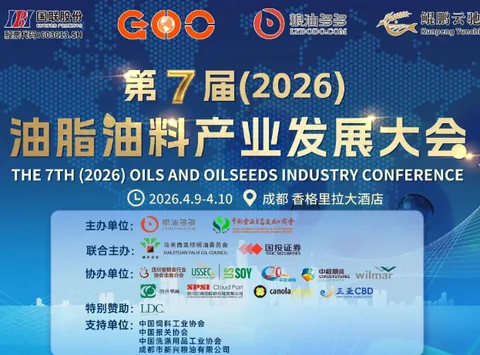 Agenda Released for the 7th (2026) Oilseeds and Oils Industry Development Conference
 -
Analysis of China's feed market in early 2026: soybean meal trades at 2,936 RMB/ton with cautious optimism, while corn sees modest gains. Key factors include post-holiday restocking and supply chain dynamics.
-
The Hong Kong Shipowners Association welcomes and supports the 2026-2027 Budget, which incorporates a number of its recommendations, including tax concessions for commodity traders, incentives to register green fuel-powered vessels, optimising the ship registration system, organising international maritime events and promoting green shipping and digital transformation. Song Ruizhi, chairman of the Shipowners' Association, pointed out that these measures will help to cope with geopolitical and decarbonization challenges and consolidate Hong Kong's status as an international shipping center, and called on the government to expand the maritime talent training fund to attract young people to join the industry.
-
A breakthrough fermentation technology enables safe replacement of 15% soybean meal in feed, cutting costs by $12-15/ton while improving livestock health and reducing antibiotic use.
-
On February 25, 2024, Premier Li Qiang of the State Council and German Chancellor Mertz jointly attended the Sino-German Economic Advisory Committee Symposium in Beijing. Li Qiang emphasized that in the face of world economic instability and rising protectionism, China and Germany, as the two major economies, should strengthen cooperation and jointly respond to challenges. He pointed out that the two sides should consolidate cooperation in traditional fields, seize emerging opportunities, and create a good business environment to achieve a higher level of mutual benefit and win-win results. Mertz said Germany is committed to deepening bilateral economic and trade cooperation and welcomes Chinese enterprises to invest in Germany.
-
Jianxin Tianjin Lingang Port REIT, as the country's first single port public offering REITs, officially declared, marking an important breakthrough in asset securitization in China's port industry. The project was initiated by Tianjin Lingang Development Group and is based on its 14 berths. It aims to revitalize the existing port infrastructure and inject new financial momentum into port upgrading and marine economic development. Relying on the location and industrial advantages of Tianjin Dagukou Port Area, the project practices the port-industry-city integration model of "promoting production with Hong Kong and prospering the city with production", which not only innovates the financing channels of port enterprises, but also provides a replicable demonstration sample for the high-quality development of the industry.
-
Mall
-
Asia Pavilion
- China
- Vegetable
- Fruit Category
- Aquatic Product
- Grains And Products
- Tea
- Meat And Products
- Other Characteristic Agricultural Products
- India
- Rice
- Spice
- Aquatic Product
- Meat
- Sugar And Sugar Products
- Tea
- Cotton And Textiles
- Fruit
- Vegetable
- Thailand
- Rice
- Oil
- Rubber
- Tropical Fruits
- Aquatic Product
- Cassava And Its Products
- Sugar And Sugar Products
- Meat
- Flowers And Plants
- See more of Vietnam
- Rice
- Fruit Category
- Coffee
- Aquatic Product
- Nut
- Wood Products And Forest Products
- Rubber And Products
- United Kingdom
- Palm Oil
- Coffee
- Aquatic Product
- Rubber And Products
- Cocoa And Its Products
- Spice
- Rice
- TüRkiye
- Nuts And Dried Fruits
- Fresh Fruit
- Olives And Olive Oil
- Grains And Legumes
- Egg
- Aquatic Product
- Cotton
- The Philippines
- Fruit
- Aquatic And Seafood Products
- Nuts And Products
- Coffee And Its Products
- Other Agriculture Products
- Pakistan
- Rice
- Fruit Category
- Vegetables
- Nuts And Products
- Sugar And Sugar Products
- Aquatic Product
- Cotton
- Israel
- Fruit Category
- Vegetables
- Flowers And Plants
- Cotton
- Other Agriculture Products
- Dairy Products
-
America Pavilion
-
Africa
-
Europe
- Netherlands
- Flowers And Ornamental Plants
- Vegetable
- Dairy Products
- Meat
- Fruit
- Seeds And Seedlings
- Fish And Seafood Products
- Germany
- Dairy Products
- Meat And Meat Products
- Grains And Grain Products
- Wine
- Sugar And Candy
- Vegetables And Fruits
- Animal Feed
- France
- Grain
- Liquor
- Dairy Products
- Meat And Meat Products
- Sugar And Candy
- Animal Feed
- Vegetables And Fruits
- Seafood And Seafood Products
- Spain
- Grains And Grain Products
- Olive Oil
- Dairy Products
- Wine
- Meat
- Fish And Seafood Products
- Fruit
- Vegetable
- Italy
- Wine
- Olive Oil
- Noodles And Cereal Products
- Cheese
- Vegetables And Fruits
- Meat And Meat Products
- Coffee And Coffee Products
- Candy And Chocolate
- Belgium
- Dairy Products
- Chocolate And Cocoa Products
- Meat And Meat Products
- Animal Feed
- Liquor
- Vegetables And Fruits
- Flowers And Ornamental Plants
-
Oceania
-
Other Pacific Island Countries
-
- RAOT STR 20
- Warehouse Services
- Integrated logistics
- Expo Services
- Trade Assurance
- Financial Services