The only “five-type” hub in East China! Why is Nanjing able to shoulder the “hardcore” logistics leadership role in the Yangtze River Delta?
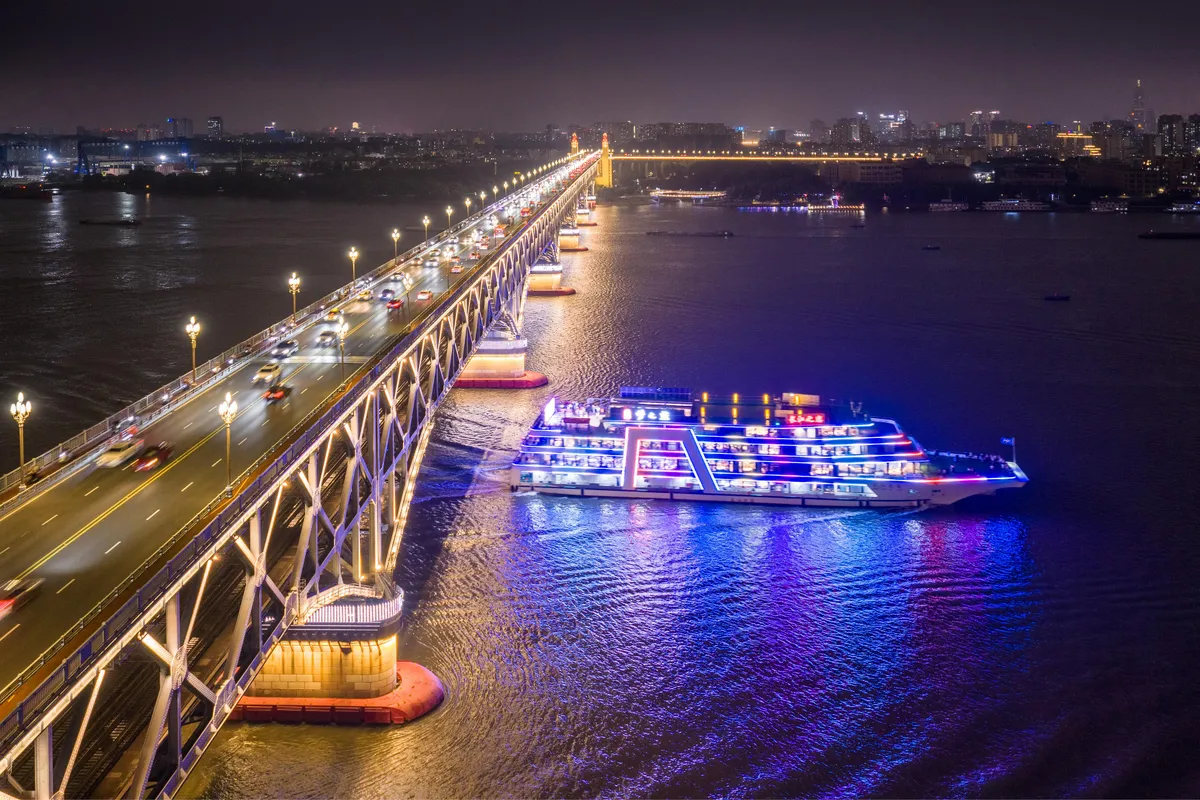
Only three cities nationwide, and the only one in East China. In early 2025, the National Development and Reform Commission issued the "National Logistics Hub Layout Optimization and Adjustment Plan," and Nanjing was simultaneously selected as a carrier city for five types of national logistics hubs: port-type, inland port-type, airport-type, production service-type, and trade service-type. This marked the completion of the "five-type" qualification coronation for this Yangtze River city. In 2026, at the start of the "15th Five-Year Plan," Nanjing delivered another "hardcore answer": in 2025, Nanjing Port's container throughput exceeded 4 million TEUs, an 8.2% year-on-year growth, international freight trains covered 15 countries across Asia and Europe, and the national backbone cold chain logistics base with a total investment of 4.656 billion yuan accelerated its progress.
With "100-million-ton port," "10-million-level airport," and "national-level high-speed rail hub" as its three core resources, Nanjing leverages the coordinated advantages of "air, rail, water, and road" to build an efficient logistics circle of "half-day delivery within the metropolitan area and next-day delivery across the Yangtze River Delta." Furthermore, it connects globally with high-level openness, deeply serving the "Belt and Road Initiative" and the new dual-cycle development pattern. This "hardcore commitment" is reflected not only in the long-term layout of top-level planning but also in the specific practices of addressing industry pain points and serving enterprise development.
Ten Years of Effort: From Single-Point Layout to "Five-Type" Coronation
Nanjing's logistics hub layout has always resonated with national strategies, achieving leapfrog development from single-point positioning to full-dimensional coverage over the past decade.
As the only "five-type" logistics hub carrier city in East China, Wu Yao, Deputy Director of the Comprehensive Planning Division of the Nanjing Municipal Transportation Bureau, introduced that in recent years, Nanjing has focused on its positioning as an international comprehensive transportation hub city, leveraging its advantages in river-sea transshipment and land-air linkage. It has promoted the construction of "hard connectivity" such as Longtan rail-water integration and "soft connectivity" platforms for multimodal transport, integrated into the Yangtze River Delta integration strategy, and advanced the fusion of transportation logistics resources with industries, achieving integrated development of ports, industries, cities, shipping, and trade.
In 2010, the national planning level first proposed Nanjing's positioning as a Yangtze River shipping logistics center, setting the core direction for the city's logistics development. In 2016, the "Yangtze River Economic Belt Development Plan Outline" further positioned it as a regional shipping logistics center, officially incorporating it into the national strategic framework. Entering the new era, Nanjing's hub qualifications accelerated their implementation: in 2019, it was selected as one of the first port-type (production service-type) national logistics hubs; in 2022, it obtained airport-type national logistics hub qualifications; in October 2024, the "Nanjing Port Master Plan (2024–2035)" was jointly approved by the Ministry of Transport and the Jiangsu Provincial Government, establishing a "one port, thirteen districts" development pattern. In the same year, a special development plan was issued, clarifying long-term goals for 2030 and 2035.
In 2025, Nanjing successfully gathered all "five-type" qualifications, becoming the only "five-type" logistics hub carrier city in East China, taking a solid step toward becoming a comprehensive international logistics hub and laying a solid foundation for expanding openness and smoothing international logistics channels.
This leap forward is inseparable from strong provincial-level support. "In Nanjing's 'five-type' hub construction, Jiangsu Port Group's subsidiary Nanjing Port Group closely aligns with the construction of Nanjing's port-type (production service-type) national logistics hub, striving to build a river-sea transshipment gateway hub for the Yangtze River Delta and central-western regions," said Chen Ming, Party Secretary and Chairman of Jiangsu Port Group, in an interview. Nanjing Port has opened direct shipping channels to multiple regions, undertaken all crude oil transshipment for the upper and middle reaches of the Yangtze River, ranked first nationwide in copper concentrate transshipment volume, and established the main rail-water intermodal channel for bulk materials in central-western China, providing solid port support for the "five-type" hub.
Wu Yao introduced that in 2026, Nanjing will focus on advancing preliminary work for the third phase of Lukou Airport, increasing international flight routes, promoting Nanjing Port as the "best container export gateway for the metropolitan area," and fully applying for the title of a national comprehensive freight hub city to strengthen and extend logistics chains.
The "hardcore commitment" is by no means achieved overnight but is the result of decades of deep cultivation in transportation logistics, closely following national strategies, and rigorously implementing infrastructure projects. It is embedded in the resonance between top-level planning and project breakthroughs, integrated into the deep fusion of multimodal transport and industrial empowerment, and ultimately reflected in the practice of actively serving the national openness agenda and smoothing domestic and international dual cycles. This transformation has become the core driving force for the city's logistics capability upgrade and enhanced regional economic influence.
The sustained release of this driving force is inseparable from breakthroughs in key projects and the coordinated efforts of sea and air ports.
Connecting Rivers and Seas: Sea and Air Ports Accelerate Construction
Nanjing is an important central city and industrial development hub in eastern China. As a key base for advanced manufacturing nationwide, it has formed four pillar industries: petrochemicals, steel, electronics, and automobiles, boasting one 800-billion-yuan, one 300-billion-yuan, and four 200-billion-yuan emerging industrial clusters.
Rapid economic development and strong market demand are driving the gradual optimization and upgrading of the logistics supply chain. The years 2024 to 2025 are critical for Nanjing's logistics hub construction, with sea and air ports driving progress side by side. A series of major projects have been implemented, solidifying the logistics foundation for connecting rivers and seas and linking globally, while addressing pain points in oversized logistics across the Yangtze River and filling gaps in special cargo transportation.
Sea port construction is advancing steadily. In 2024, the regional shipping logistics center construction promotion meeting finalized 32 key projects with direct investment of 40.016 billion yuan. After the Yangtze River Pilot Center settled in, it ensured the regular entry and exit of 100,000-ton bulk cargo ships, fully utilizing the 12.5-meter deep-water channel. "With the full release of the 12.5-meter deep-water channel's efficiency, large sea vessels with a draft of 11.6 meters have achieved regular berthing at Nanjing Port, and vessels with a draft of 11.8 meters have berthed for the first time, significantly enhancing the main hub port's river-sea transshipment capability," said Niu Jianping, Party Secretary of Nanjing Port Group.
This breakthrough has significantly improved Nanjing Port's river-sea transshipment capacity, providing more efficient channel guarantees for the import and export of foreign trade goods and laying the foundation for addressing local heavy equipment transportation pain points.
On September 30, 2025, the seventh phase of Longtan Port Area and the railway dedicated line capacity expansion and efficiency enhancement project commenced, with a total investment exceeding 1.2 billion yuan. Niu Jianping stated that the seventh phase of Longtan Port Area will be built into the first fully automated wood chip terminal in the Yangtze River Basin. After the railway dedicated line expansion, loading and unloading capacity will be improved, supporting high-quality operation of along-the-river freight trains and expanding rail-water intermodal business.
With the advancement of a series of key terminal reconstruction and capacity expansion projects, Nanjing Port's freight and container transit capacity will achieve significant upgrades, maintaining its position as a core port in the Yangtze River Basin. Foreign trade container business continues to grow, near and far ocean route networks are constantly improving, making it an important port for the Yangtze River Delta's openness to the outside world.
The air port's capability continues to climb, with Lukou Airport entering the ranks of "super-large airports." Over the past three years, Nanjing Airport's cargo and mail throughput has steadily increased, with a three-year growth rate of 26%, and international and Hong Kong, Macau, and Taiwan cargo and mail throughput growth of 55%, weaving a network of 14 international and Hong Kong, Macau, and Taiwan all-cargo flight points. Zhou Chengyi, Party Secretary and Chairman of Eastern Airport Group Co., Ltd., used a set of impressive data to decode how Nanjing Airport helps "Made in China" connect globally.
Since 2025, Nanjing has accelerated the advancement of Lukou Airport's freight hub project and planned to increase international freight routes to more than five by 2027, cultivating multiple low-altitude logistics companies, building a fast air freight channel, and forming complementary interactions with sea ports, opening up air logistics corridors to Europe, the United States, Japan, South Korea, and Southeast Asia.
In the integrated linkage of "air, rail, water, and road," Zhou Chengyi added that Nanjing Airport uses digital platforms to break down information barriers, promotes the construction of remote cargo stations, and deepens the "ground-air transfer" model, achieving efficient coordination between air freight and rail-water-road transport, integrating into the unified logistics framework. "We have long focused on truck flight business, actively connecting with inspection units, enhancing the efficiency of cargo handling and transportation throughout the chain. Cargo is efficiently transferred from Nanjing Airport to cities like Shanghai, Beijing, and Tianjin, continuously amplifying the radiation capability of Nanjing Airport's port." According to reports, by 2025, Nanjing Airport has established a truck service area covering the entire country, achieving truck flight connectivity to 25 key cities, cumulatively ensuring the transfer of 10,000 tons of cargo, a year-on-year growth of 4.6%, achieving "seamless connection" between air freight and land transportation.
Model Innovation: Weaving a Dense Cross-Border Logistics Network
The core competitiveness of Nanjing's logistics hub lies not only in the capability enhancement of individual transportation carriers but also in the innovation of multimodal transport models, thoroughly breaking through the "microcirculation" of regional logistics. This model innovation is reflected in the linkage between railways and ports and the efficient operation of international freight trains.
Since the implementation of the Yangtze River Economic Belt development strategy, Nanjing has been laying out rail-water intermodal transport, building three major rail-water intermodal hubs: Longtan, Xiba, and Xinshengwei. In 2019, multimodal transport projects were approved as national demonstration projects. By 2025, multimodal transport development entered the fast lane, with the northern Yangtze River high-speed rail accelerating construction, Longtan container handling station completing renovations, and cross-border specialized modes such as "China-Europe freight train + bonded" and photovoltaic product direct freight trains taking shape, continuously expanding the coverage of international freight trains.
As the core carrier of Nanjing's railway logistics system, connecting railway freight trunk lines, linking multimodal transport, and ensuring the efficient operation of international freight trains, the Shanghai Railway Bureau Nanjing Railway Logistics Center provides solid support for Nanjing's multimodal transport model innovation and smooth industrial supply chains.
Jiang Jian, Manager of the Freight Train Products Department at the Marketing Division of the Shanghai Railway Bureau Nanjing Railway Logistics Center, has witnessed the route updates and model development of China-Europe (Asia) freight trains. He introduced that the Nanjing-to-Central Asia and Nanjing-to-China-Russia routes are boutique lines of Nanjing's China-Europe freight trains, mainly providing customized services for Nanjing's local manufacturing industry and dedicated train services for provincial and municipal key enterprises, such as logistics cost control, customized schedules, and tailored routes. "Freight train transportation time is halved compared to sea transport, providing a broad channel for enterprises to expand overseas markets. In recent years, we have also been exploring new models, hoping to transform logistics hubs from 'hardware aggregation' to 'efficiency enhancement.'"
According to the plan, by 2027, Nanjing will stably operate 20 multimodal transport routes, achieving scaled application of "single document system" and "single container system," maintaining an average annual growth of 10% in multimodal container transport volume, achieving efficient linkage of air, rail, water, and road transportation modes, promoting deep integration of international and regional logistics, and providing strong support for integrated development of domestic and foreign trade.
The implementation of this plan relies on the support of professional operating platforms. Jiangsu International Freight Train Co., Ltd. plays the role of "land-based international channel builder" and "multimodal transport operator" in Nanjing's multimodal transport system construction. "Leveraging coordination advantages, we precisely connect customs and railway departments, promoting the regular operation of freight trains. We have successfully built a channel network covering 26 countries and nearly 80 stations, with Nanjing stably operating eight international freight train routes," said Chen Yumao, Party Secretary and Chairman of Jiangsu International Freight Train Co., Ltd.
Under the background of coordinated development of "five-type" hubs, Chen Yumao acknowledged encountering "new opportunities": "We will fully utilize the functional advantages of free trade zones and comprehensive bonded zones, actively collaborate with the China-Central Asia Trade Facilitation Cooperation Platform, accelerate the cultivation of new business models such as 'freight train + trade,' 'freight train + bonded,' and 'freight train + industrial park,' actively attracting cross-border e-commerce and import-export processing industries, effectively promoting the internationalization of Nanjing and the Yangtze River Delta's trade circulation industry, and building a cross-border trade logistics network oriented toward the 'Belt and Road Initiative.'
Precise Problem-Solving: Activating Hub Warmth with Quality Services
Taking on the "hardcore commitment" of Yangtze River Delta logistics, Nanjing not only focuses on hardware infrastructure but also emphasizes optimizing the soft environment. Through policy empowerment, intelligent upgrades, and green transformation, it achieves cost reduction and efficiency improvement in logistics while seizing new opportunities in the airspace economy, creating new logistics development scenarios that benefit the real economy and market entities.
Policy dividends have been continuously released over the past three years: in 2023, Nanjing was selected as Jiangsu's only national backbone cold chain logistics base; in 2024, research was conducted to establish a shipping development fund and introduce port logistics support policies; in 2025, a transportation logistics cost reduction and quality improvement plan was launched, attracting leading shipping companies to gather and promoting the landing of high-end shipping service industries. Longtan Container Terminal achieved automated unmanned operations, pure battery-powered ships and new energy charging and swapping stations were rapidly promoted, creating a green and low-carbon freight corridor.
The airspace economy has become a new highlight in Nanjing's logistics quality improvement and efficiency enhancement. In March 2026, Nanjing's first "city-island-river" low-altitude three-dimensional hub was officially announced to be located on Eco-Tech Island and began trial operation on March 8, opening multiple regular drone routes from Hexi Main City to Jiangxinzhou. Cross-river drone flights take only 4 minutes, with the overall delivery loop controlled within 10 minutes, improving logistics efficiency nearly 30 times compared to traditional ground transportation. This creates a new low-altitude logistics ecosystem integrating water and land, filling the gap in low-altitude logistics services in the Yangtze River Basin. It is an innovative practice in the integrated development of trade service-type and airport-type hubs. According to Ge Jiashan, Co-Founder and General Manager of Jiangsu Yangtze Hui Aviation Technology Co., Ltd., by 2025, "Hui Flash Delivery" had completed 55,000 flights, achieving a delivery success rate of over 99%, saving 120 tons of diesel annually, reducing CO₂ emissions by 90 tons, and replicating the model in multiple cities along the Yangtze River, becoming a "Nanjing model" for inland low-altitude economy.
From new low-altitude logistics scenarios to major equipment transportation, Nanjing uses precise services to address industry logistics pain points.
To meet the transportation needs of high-end manufacturing and heavy equipment industries in the Yangtze River Delta, Nanjing has specifically optimized the layout of oversized logistics cross-river channels, stabilizing the supply chain for new energy and high-end equipment industries, safeguarding the development of advanced manufacturing, and making the service efficiency of sea port hubs more aligned with industry development needs. "Focusing on heavy equipment cross-river and wind turbine blade port entry bottlenecks, we connect with leading enterprises through intelligent platform closed-loop management, multi-department coordinated guarantees, and the establishment of a dedicated oversized equipment channel at Banqiao Ferry, efficiently ensuring major equipment transportation," said Xue Hai, Deputy Director and Party Member of the Nanjing Municipal Transportation Bureau, in an interview. Nanjing's pioneering "ferry + oversized equipment" cross-river channel fills the gap for oversized equipment over 120 tons, while advancing a classified service model for oversized transportation based on "credit-based approval" and "one-on-one" approaches, optimizing oversized transportation permit application processes, adding "AI application functions," and making oversized transportation approval one of the "excellent cases" in "government service one-stop solutions."
Measures to optimize the business environment have been implemented effectively, including regular visits to logistics key enterprises, precise resolution of development demands, integrated approval processing, conditional supplementary submissions, advanced inspections, implementation of reduced guarantee deposits for trustworthy enterprises, logistics credit support, differentiated highway tolls, and other enterprise-friendly initiatives. The Nanjing transportation department uses customized channels and professional services to ensure that the "hardcore hub" has both strength and warmth.
From locking in the positioning of a shipping logistics center in 2010 to achieving full coverage of "five-type" hubs in 2025, and then riding the momentum at the start of the "15th Five-Year Plan" in 2026, Nanjing has completed the capability upgrade and value transformation of its logistics hub in just over a decade. From addressing oversized cross-river logistics pain points to seizing new airspace economy opportunities, from smoothing the domestic "big cycle" to linking the global "dual cycle," the qualification of East China's only "five-type" hub is not only recognition of its comprehensive transportation strength by the nation but also a responsibility to serve the Yangtze River Delta integration and the Yangtze River Economic Belt development strategy.
In the future, Nanjing will focus on the integrated development of "five-type" hubs, aiming to basically build a regional shipping logistics center by 2030 and an internationally competitive comprehensive logistics hub by 2035. It will weave a full-domain logistics network of "air, rail, water, road + low-altitude," activate industrial momentum through hub economy, and inject continuous and strong logistics driving force into the construction of a world-class port cluster in the Yangtze River Delta and high-quality regional integration development.
-
Zhoushan Maritime Authority Fully Ensures Water Transportation During the National Day Holiday Peak4802
-
Jiangyin Maritime Authorities Fully Escort the Public for Safe River Crossing3107
-
Tell the story of modern China in the new era through the shared emotions of humanity.3645
-
The 2026 Hong Kong Airlines Publicity, Ideology, and Culture Work Training Program will be held in Ningbo at the end of October.4660
-
The Second Guangzhou Ship Management Technology Exchange Conference was successfully held.4994