Watching the tide and reading the thousand years to start a new journey to the sea-the four background colors of Fujian's water transport civilization and the thousand-year echo
Fujian, with its "eight mountains, one water, and one field," is shaped by its mountains and endowed with the spirit of the sea. Its 3,700-kilometer coastline stretches out like an arm embracing the Pacific Ocean, while the Min River, Jin River, Jiulong River, and Ting River run through the province like lifeblood. For thousands of years, ships have come and gone, tides have risen and fallen, and the waves of different eras have washed over the cultural layers, creating a multidimensional history of Fujian's maritime civilization.
To understand this history of civilization, one might follow the tides of time upstream, observing the winding coastline port by port—from the bustling maritime Silk Road of the Tang and Song dynasties to the poignant explorations of modern shipbuilding; from the revolutionary era's red waterways to today's revival wave of the "Maritime Silk Road." Ports, navigation marks, ferries, and shipyards are like scattered pearls, stringing together a cultural map along Fujian's coastline, showcasing four fundamental colors of Fujian's maritime culture: openness in trade, resilience in responsibility, revolutionary sincerity, and ambitious revival.
Sails of Nations: The Civilized Symphony of Maritime Trade
In the 9th century, when Arab merchants' triangular sailboats first entered Quanzhou Bay, they saw a natural deep-water harbor and a city open to the world. At that time, the port of Zayton was bustling with masts like forests and foreign merchants gathering, creating a flourishing scene of "ten thousand merchants in the sound of the rising sea" that lasted for centuries. In the second year of Yuan You in the Northern Song Dynasty (1087), the imperial court established the Shibo Si in Quanzhou—the only surviving ancient customs site in China—where merchant ships declared goods, underwent inspections, and paid taxes. The system design of "valuing imports and lightening exports" made Quanzhou Port the most efficient trading hub in Southeast China. East African ivory, Arabian spices, Persian glassware, Jingdezhen blue-and-white porcelain, northern Fujian tea, and Jiangnan silk converged, circulated, and sailed from here. Marco Polo marveled in his travelogue that "Zayton Port is one of the largest ports in the world," while Ibn Battuta recorded the grand scene of "hundreds of large ships and countless small boats."
This trade-driven impulse left behind the densest cluster of ports along Quanzhou Bay. Linluan Ferry, located on the Shihu Peninsula in Shishi, was excavated by Tang Dynasty navigator Linluan for navigation to Borneo (modern-day Brunei) and became a pivotal land-water transfer hub during the Song and Yuan dynasties, giving rise to the bustling "Du Wei Street." Correspondingly, the ancient Anping Ferry guarded Weitou Bay and, with its "nine bays and eighteen bends" wind-sheltered terrain, became a stable refuge for merchant ships. During the Southern Song Dynasty, the locals spent 14 years building the five-li-long cross-sea Anping Bridge, integrating bridge and ferry, with a white pagoda guiding navigation. It connected Quanzhou to the north and Xiamen and Zhangzhou to the south, rivaling the prosperity of a major city. In the Ming Dynasty, Anhai further developed, and Anping merchants "traveled the rivers and lakes, leaving footprints all over the world."
On the north and south shores of Meizhou Bay, two ancient ports also wrote their own commercial legends. On the southern shore, the Tuxing Port City, relying on the deep waters and wide harbor of Xiaocuo and the natural wind-sheltered advantages of Fengwei Port, formed a unique layout of "one port, two streets, one dock." In the second year of Yongle in the Ming Dynasty (1404), the Liu Zongkong family from Putian moved here, establishing three maritime merchant fleets that reached as far south as Luzon and as far north as Nagasaki. The streets of Shibu Kou and Citang Kou were lined with shops, and the "Million Mansion" built by maritime merchant Liu Duanhong, along with 26 other ancient mansions, still stand today, forming the best-preserved maritime Silk Road port city ruins in Quanzhou. On the northern shore, Putian's Jile Port, established in the fourth year of Xining in the Northern Song Dynasty (1071), was already a bustling hub for Fujian markets during the Song and Yuan dynasties. Merchant ships from Putian, laden with tea and porcelain, sailed to Southeast Asia, West Asia, and even Africa, returning with spices, ivory, and other imported goods. After the Ming Dynasty lifted the maritime ban, "merchant ships, large and small, lined up one after another," and the local saying "One day to Jile, three days to talk about it" captured the prosperity of the time. A hundred-meter stone fortress wall and the ancient architectural complex of the Golden Rooster Temple still stand today, bearing witness to the eight scholars and eighteen scenic spots that have written a vivid footnote to Putian's reputation as the "coastal land of culture."
Since the first year of Longqing in the Ming Dynasty (1567), when maritime trade was opened, Zhangzhou's Yuegang Port took the lead. At the mouth of the Jiulong River, a crescent-shaped port channel surrounded the area, with seven ancient docks lined up along the river, each serving its purpose—tax collection at Xiangguan Dock, foreign ship berthing at Lutouwei Dock, large-scale operations at Rongchuan Dock, daily goods trading at Dianzi Dock, military berthing at Agobo Dock, and inland ship reception at Xiewei Dock. Each year, about 150 Minnan merchant ships sailed directly to Manila, where Spanish galleons transported goods to the Americas, connecting the maritime Silk Road across the Pacific Ocean. It is estimated that by the late Ming Dynasty, 330 million taels of silver flowed into China through Zhangzhou's Yuegang Port, accounting for about one-third of the world's production at the time, earning Yuegang the title "Southern Treasury of the Emperor." Meanwhile, on the inland waterways of Shangxiahang in Fuzhou, tea, paper, timber from northern Fujian, and foreign goods converged. Marco Polo's travelogue described Fuzhou's Taijiang as "a large river running through the city... with large, beautiful buildings on both sides and numerous ships anchored in front."
From the Tang and Song dynasties to the Ming and Qing dynasties, Fujian's port clusters have always been China's frontier to the ocean. This openness was not just about the flow of goods but also a dialogue of civilizations. Arab navigation techniques, world maps from Western missionaries, and the overseas experiences of Chinese expatriates all entered Fujian with the tides, shaping the broad vision and pioneering spirit of its people. This is the original color of Fujian's maritime culture: treating the sea as farmland, using boats as plows, and cultivating an open and fertile land for the world.
Shipbuilding for National Strength: The Backbone of Maritime Defense Culture
Where trade flourishes, there must be security barriers. Most of Fujian's ancient ports served dual economic and military functions, acting as gateways to the nation and strategic choke points for controlling rivers and seas. As early as the Han and Tang dynasties, Min'an Xing Port at the mouth of the Min River was established as a navigable port, serving as the "first gateway" for foreign merchant ships entering Fuzhou. A tax office was set up during the late Tang Dynasty, and a patrol office was established during the Song Dynasty, with the number of officials increasing from 60 to 180 and heavy troops stationed year-round. Min'an, named for "securing and stabilizing Fujian's borders," integrated commerce and maritime defense, serving as a powerful testament to Fujian's martial spirit in defending its territory.
At the northeastern corner of Xiamen Island, Wutong Ancient Ferry also carried out a maritime defense mission. Since the Song Dynasty, it was an important stop on Xiamen's ancient post road, and it is said that the young emperor of the Southern Song Dynasty landed here while fleeing south. In the Ming Dynasty, Wutong Fort was established, complete with smoke mounds and watchtowers, and troops were stationed there, forming a strategic triangle with Liu Wudian across the sea. During the Qing Dynasty, "Wutong Pu" was designated as a transit station for Taiwan garrison troops, standing as a maritime defense outpost for centuries. Today, it has transformed into the golden gateway of the "mini three links" between Xiamen and Kinmen, witnessing the historical changes in cross-strait exchanges. As history entered the 19th century, the ocean brought not only wealth and glory to Fujian but also humiliation and awakening. The cannon fire of the two Opium Wars made the tides at the mouth of the Min River heavy with sorrow. However, it was this region, the first to have its doors forcibly opened, that also first sounded the call for self-strengthening. In 1866, Zuo Zongtang and Shen Baozhen established the Fuzhou Arsenal at Mawei, creating a modern industrial base for shipbuilding, military training, and education along the Min River. This base produced China's first thousand-ton steamship "Wan Nian Qing" and its first fully steel-armored warship "Ping Yuan." They also founded China's first modern naval academy—the Fuzhou Naval Academy—where students learned French for shipbuilding and English for navigation. The academy produced 629 graduates, including Yan Fu, Zhan Tianyou, and Deng Shichang. During the First Sino-Japanese War, 11 of the 12 captains of the Beiyang Fleet's main warships were alumni of the academy, marking the beginning of the legend "No Navy Without Fujian." In the 1884 Battle of Mawei, the Fujian Fleet's heroic sacrifices awakened the nation's awareness of maritime rights. Mawei transformed from a mere commercial port into the cradle of the nation's maritime defense industry.
From the mouth of the Min River to Xiamen Port, coastal fortresses, naval camps, and shipyards formed the initial framework of China's modern maritime defense system. The spiritual legacy of shipbuilding culture—learning from foreign expertise, revitalizing the nation through industry, and strategizing for the ocean—remains the most robust aspect of Fujian's maritime spirit.
Sparks Across the River: The Revolutionary Journey of Red Waterways
Fujian's water transport map includes not only sea routes to the world but also inland rivers leading to revolution. The Ting River, Han River tributaries, and Min River form a secretive and resilient red water transport network.
The Ting River was the most crucial waterway in the Central Soviet Area. On May 20, 1929, Mao Zedong and Zhu De led over 3,000 soldiers of the Fourth Red Army to the Zhuotian Shuikou Ferry in Changting. It was flood season, and the river was raging. Boatman Lan Xinglang mobilized 16 boatmen and found eight wooden boats to ferry over 3,000 people and dozens of warhorses across the river in more than six hours. Mao Zedong wrote, "The red flag leaps over the Ting River, heading straight to Longyan and Shanghang." This route, stretching from Shanghai through Hong Kong and Shantou, along the Han River and Ting River into western Fujian and then to Ruijin, served as the "lifeblood of the Soviet." It safely transported over 200 revolutionary leaders, including Zhou Enlai, Liu Shaoqi, Deng Xiaoping, and Ye Jianying, into and out of the Soviet Area, along with thousands of tons of military and civilian supplies. After the Red Army's Long March, the Ting River's water guerrilla team, led by boatmen from Shuikou Village, transported hundreds of thousands of kilograms of grain and large quantities of military supplies. Shuikou Village has 68 registered martyrs.
A branch of the Han River system was equally significant. Wuping's Xiaba Market directly connected to the upper reaches of the Han River, serving as a vital liaison station for the border areas of Fujian, Guangdong, and Jiangxi entering the Central Soviet Area in southern Jiangxi. In October 1927, after the defeat of the Nanchang Uprising forces at Sanheba, Zhu De led a unit back to Jiangxi via Wuping's Xiaba Market waterway. This route primarily relied on civilian boats, with steep riverbank cliffs providing concealment. The central red transportation line branched westward into Wuping's Xiaba, passing through Wusuo and Dongliu into southern Jiangxi's Xunwu and Huichang, eventually reaching Ruijin, transporting large quantities of scarce supplies such as salt and medicine.
The waterborne struggles on the Min River continued into the Liberation War period. Between 1931 and 1935, the Communist Party's Fuzhou Central Municipal Committee established secret water transport liaison stations from Fuzhou's Taijiang to Lianjiang's Guantou and Wuzhu. After the victory of the War of Resistance Against Japan in 1945, the Communist Party of Fujian Province developed party members and established party organizations within the Min River Shipping Company, opening an underground route from Fuzhou to Nanping. Underground party members departed from Taijiang Wharf, transporting weapons, radios, and medicine to guerrilla forces in Nanping. More than ten reception points were set up along the Min River's banks, including Xiangshan, Yuexi, Chayang, Jinsha, Jixi, Xiadao, and Yanfu Gate Wharfs. This route persisted until Fujian's liberation. In 1959, this history was brought to the silver screen, and the film "Underground Route" spread across the nation.
In modern Fujian water transport, the underlying color is sincerity. Those silent ferries, hidden docks, and perilous waterways carried the hope of a nation seeking liberation and independence. The boatmen who risked their lives to maintain these routes created a wave of light in revolutionary history that should never be forgotten.
Sailing the Silk Road: A New Chapter of Revival and Global Connectivity
The tides of history have never ceased. From the glory of the "Oriental First Port" during the Song and Yuan dynasties to the poignant explorations of modern shipbuilding and the sacrifices along the red waterways, as China reopens its doors, ancient ferries and modern port zones shine together along Fujian's coastline, with historical accumulation converging into a powerful force for maritime strength.
The ancient Aotou Ferry in Xiamen was established during the Song Dynasty. In the first year of Daoguang (1821), one of China's earliest cargo ships sailed directly to Singapore, initiating a large-scale migration wave of Minnan people to Southeast Asia. Today, not far from the ancient ferry, Xiamen Port's Xiang'an Port Area has taken on the historical responsibility of becoming an important port for cross-strait "three links." Shijing Port, a thousand-year-old port facing Kinmen across the sea, was documented as early as the Sui Dynasty. During the late Ming Dynasty, Zheng Chenggong and his father established "five major commercial firms for sea and land routes" here. In 2006, the Quanzhou-Kinmen passenger route opened, transporting over 1.6 million passengers and connecting the blood ties between the two sides of the strait. This year, six new 10,000-ton berths at the Shijing Operations Area of Quanzhou Port entered the final construction phase, showcasing the initial scale effect of the connected area. Nearby, Yingqian Village has transformed from a traditional fishing village into a shipping hub known as "China's First Shipping Village," with a shipping capacity of 5 million tons, accounting for over 30% of domestic coastal container shipping capacity. The Jile Port site in Putian has been incorporated into the Dongwu Port Area of Meizhou Bay Port, while its opposite shore, Luoyu Operations Area, has become one of the largest ore terminals in southeastern China. The former coastal fortress is now writing a new chapter as a deep-water port in the new era.
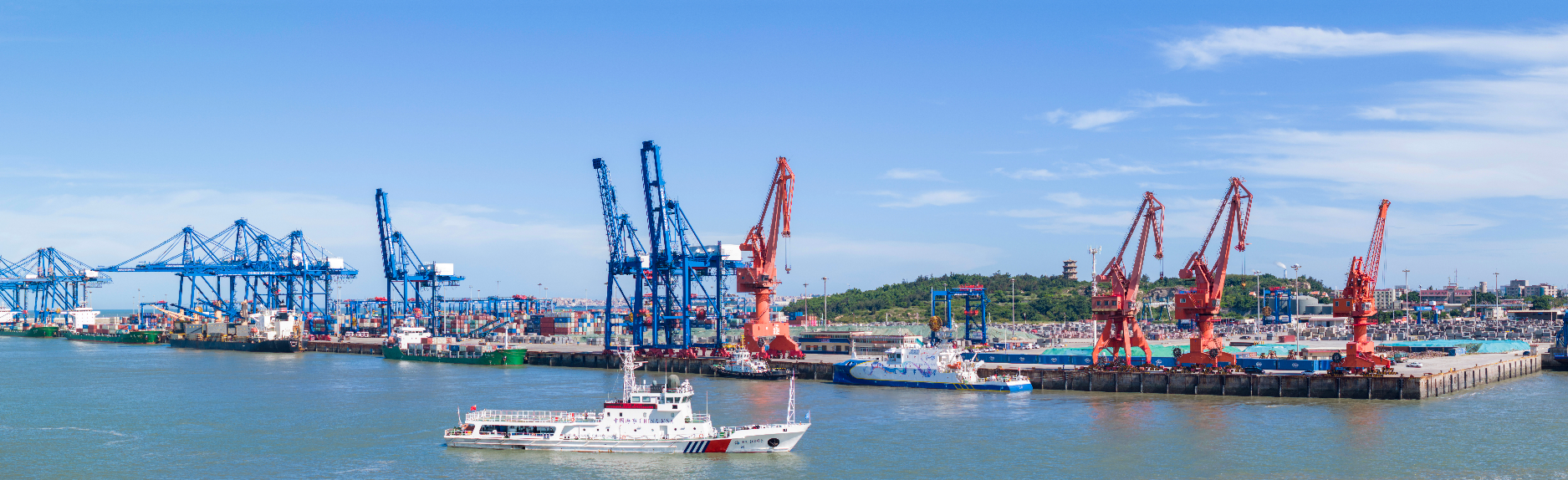
In Fujian, ports are no longer mere logistics nodes but magnets for industrial clusters, engines for regional development, and bridges for cultural exchange. At Xiamen Port's automated terminal, large-scale loading and unloading equipment precisely completes container handling and transfer, pioneering the localization of container production management systems. It has established efficient export channels for "new three items," providing specialized operational support for new energy products. The cruise home port continues to innovate, opening new Southeast Asian maritime Silk Road-themed routes and expanding new scenarios for maritime cultural tourism and international openness. Fuzhou Port has topped the global container port performance rankings, with sea-rail intermodal transport bridging the "last mile" for railway access to ports. It has opened a fast Arctic route to Europe. In August this year, Fuzhou Port's automobile roll-on/roll-off exports exceeded 50,000 vehicles, far surpassing the total for 2025, building a logistics corridor connecting southeastern coastal areas with inland regions. Meizhou Bay Port's deep-water berths handle 400,000-ton ore carriers from Brazil and Australia, forming a crucial ore energy transshipment hub in southeastern coastal China. The Shihu Operations Area of Quanzhou Port, relying on "maritime bus" feeder lines, has woven a dense network of domestic and international trade shipping, achieving coordinated linkage between Quanzhou and Xiamen ports and enabling goods to board ships nearby for export...
Entering a new stage of development, with the deepening construction of smart and green ports, Fujian continues to integrate ports, industries, and cities, enhancing its global resource allocation capabilities. With vigorous momentum, it has transformed from a "geographical endpoint" to an open frontier, turning its golden coastline into a golden economic belt for high-quality development.
By the end of 2025, Fujian will have 479 productive berths, with 46.1% being over 10,000 tons, capable of accommodating the world's largest bulk carriers, container ships, and cruise ships. By 2025, the province's coastal ports will handle 756 million tons of cargo and 18.44 million TEUs of containers. The economic added value of coastal ports will reach 795.5 billion yuan, accounting for 15.3% of the GDP of port cities, firmly placing Fujian among the nation's leading ranks. These dynamic figures vividly illustrate Fujian's determination to strengthen its maritime capabilities and connect with the world.
Looking back at Fujian's maritime civilization history, the waves stirred by the same river at different times collectively forge the spiritual lineage of Fujian people: "born by the sea, daring to lead." For a thousand years, the tides of ancient ports have never faded—they once resonated in the sails of Arab merchant ships, echoed in the morning bells of the shipbuilding academy, surged in the paddles of the Ting River's rapids, and now transform into the whistles of massive cargo ships, merging into the mighty winds of the Belt and Road Initiative.
-
Yangpu Maritime escorts the safe docking of the inaugural vessel on the "Nanning-Yangpu, Hainan" direct inland-sea shipping route.4747
-
The Youthful "Voices" Riding the Waves: A Tribute to the Beihai Maritime Safety Center's Integrated Media Studio3145
-
Chongming Maritime Launches Special Escort Operation for the 2026 East China Sea "Fishing Opening"3844
-
Zhangzhou united multiple departments to carry out a water and land traffic safety campaign in schools.4119
-
The Nanjing Riverside Cruise welcomes its 3,000th voyage.5021