Digital Intelligence Integration Empowering Collaboration for a New Voyage—China Classification Society Holds Shanghai Regional Committee's 2026 Annual Meeting
"The China Classification Society proactively serves national strategies by enhancing three major functions in Shanghai: international ship inspection business operations, ship and marine international technical standard innovation, and international exchange and cooperation in shipping technologies. It aims to make Shanghai a globalized operational hub for CCS worldwide," said Zhang Qingwen, Vice President of CCS, on October 9 at the 2026 Annual Meeting of the CCS Shanghai Regional Committee. He added that the organization will continue to strengthen its technical service capabilities in the Shanghai region, further improve the full lifecycle service system, and work with various parties to tackle industry challenges, seize development opportunities, and jointly contribute to the construction of a strong transportation and maritime nation as well as the Shanghai International Shipping Center.
The 2026 Annual Meeting of the CCS Shanghai Regional Committee, themed "Digital Safeguarding Safety and Collaborative Resilience," brought together representatives from across the industry chain, including shipping, shipbuilding, research institutions, and financial institutions, to assess trends in ship intelligence technology development and discuss high-quality development pathways for Shanghai's shipping and shipbuilding industries.
Deepening Regional Services, Empowering Industry Development
At the meeting, CCS Shanghai Branch presented the 2025 Annual Meeting action response outcomes and the 2026 performance report of the Shanghai Regional Committee. The tangible results demonstrated the responsibility and commitment to supporting the high-quality development of the shipping industry.
Turning committee members' concerns into practical measures for business reform and technological innovation. In response to suggestions and opinions from member units in the previous year focusing on carbon tax strategies, new energy technologies, intelligent ships, breakthroughs in domestic production, and financial institution services, CCS implemented dedicated action plans, achieving a 100% realization rate. Regarding international maritime carbon tax rules, the Shanghai Branch developed a carbon tax evaluation system and submitted multiple proposals to the International Maritime Organization (IMO). In the new energy sector, it completed the methanol retrofit for a large container ship and published the world's first "Inspection Guidelines for Alternative Fuel Retrofits." The Shanghai Branch also iterated and refined the "Intelligent Ship Specifications" and participated in the legislative research and rule-making for the IMO MASS Code (International Safety Code for Maritime Autonomous Surface Ships). Focused on high-value-added vessels such as large cruise ships, LNG carriers, and PCTCs (Pure Car and Truck Carriers), the branch advanced the recognition of domestically manufactured materials and equipment. It also innovated a "Technology + Finance" model to build a ship financing exchange platform. This year, leveraging its location advantage in the Shanghai International Shipping Center, the branch has been focusing on high-end shipbuilding, green and low-carbon transitions, and digital intelligence development, injecting robust technological momentum into the high-quality development of the shipping industry through landmark projects and pioneering certifications.
High-end ship inspection services achieved significant breakthroughs. The Shanghai Branch successfully completed the inspection and delivery of CCS's first single-class LNG carrier "Tianshan." It facilitated the construction of the world's largest 271,000 cubic meter QC-Max LNG carrier, verified 45 commissioning procedures and 149 sea trial projects. It also ensured the trial voyage of the second domestically produced large cruise ship "Aida Floralis" and completed a special assessment of the "Aida Metropolis" cruise ship's destination-free sea voyage, supporting the commercialization of domestic cruise ship operations.
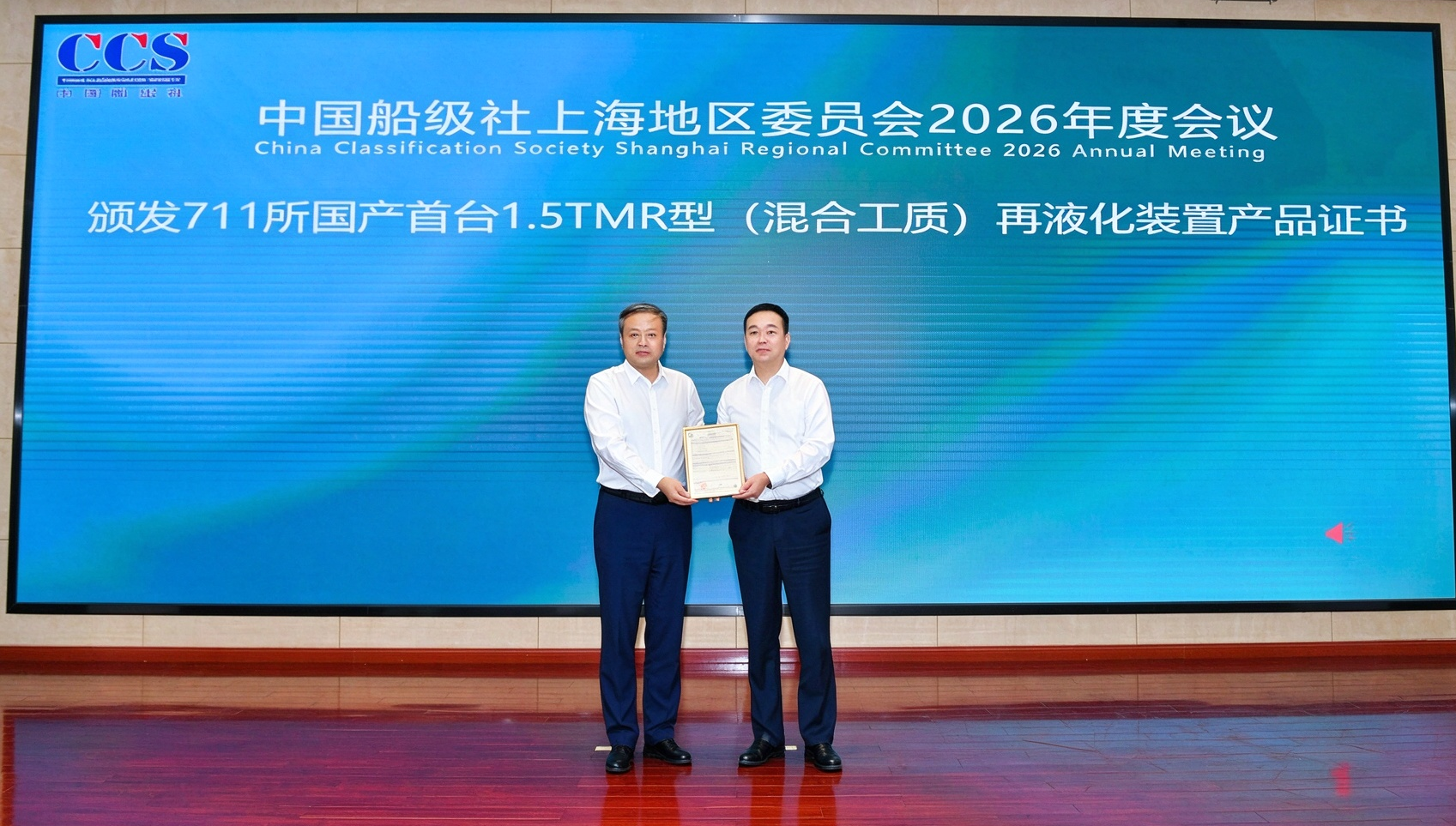
Notable progress in the green and low-carbon sector. The Shanghai Branch completed methanol fuel retrofits and stern deck height inspections for vessels "COSCO Shipping Peony" and "COSCO Shipping Jasmine." It issued the country's first carbon footprint compliance statement for container ship repairs to Shanghai COSCO Shipping Heavy Industry and facilitated the maiden commercial voyage of China's first hydrogen fuel cell river container ship "Dongfang Hydrogen Port," paving the way for commercialized hydrogen energy shipping on inland waterways. Additionally, it promoted the construction of a 300,000-ton floating dock project by COSCO Shipping Heavy Industry, complementing the ultra-large vessels and offshore platform maintenance chain in the Shanghai International Shipping Center.
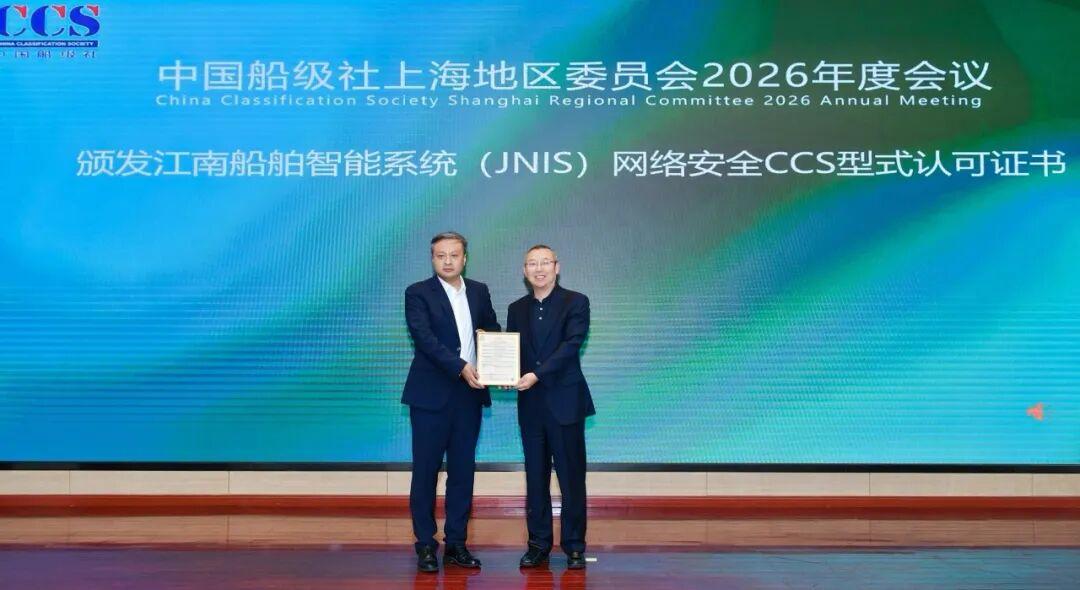
Driving the digital transformation of the industry. The Shanghai Branch pushed forward the upgrade of China's first L3-level digital recognition certificate for ship power products issued by China State Shipbuilding Corporation Power Group. It developed an "Intelligent Service Agent for Pre-contract Ship Product Certification," empowering a digital transformation across the shipbuilding value chain. The branch also carried out CCS-type approval for the cybersecurity of the independently developed "Jiangnan Ship Intelligent System (JNIS)" by Jiangnan Shipyard.
Smart Shipping Takes Root on Many Fronts
Currently, the continued evolution of the IMO's MASS Code presents new demands on technology, compliance, and safety management in the industry. CCS is keeping pace with developments, deeply engaging in MASS legislative research and rule-making, while submitting various proposals to the IMO. It is offering evaluation services for intelligent ship technology applications, risk assessments for intelligent ships and systems, and simulation testing of intelligent navigation systems to shipowners, design firms, product manufacturers, and system integrators.
Meanwhile, CCS is actively exploring the application of artificial intelligence in ship inspection by developing an AI smart standard knowledge base system for underwater transport. This system consolidates over 5,600 authoritative materials, including IMO conventions, classification society regulations, maritime laws, inspection guidelines, and circulars, along with more than 4,800 industry standards. It covers core business scenarios like ship inspection, regulatory queries, and safety checks.
Under the support of rules and technical services, domestic shipbuilding and shipping enterprises are conducting practical applications of smart shipping tailored to their business needs. Jiangnan Shipyard (Group) Co., Ltd. has introduced a smart system digital delivery solution, building a ship-shore-cloud collaborative architecture based on a unified intelligent data platform. By combining modular intelligent applications, the system connects data across the entire lifecycle of ship design, construction, and operation to allow for flexible reuse of intelligent capabilities in various delivery scenarios.
Focusing on ship operational scenarios, the human-machine collaborative mode in intelligent navigation has become a key topic in the industry. Shanghai Ocean Shipping Co., Ltd. is currently testing functions like situational awareness and collision avoidance alarms on container ships. Deputy Director of the company's Safety Supervision Department, Xu Feng, believes that human-machine collaborative navigation may become the primary operational model in the foreseeable future. Defining the division of responsibilities under this mode is crucial, with the focus on leveraging intelligent technology while maintaining safety, ensuring that it serves as an effective aid to crew members rather than a scapegoat for safety issues.
In the digitalization of ship safety management, many shipping companies are still constrained by issues like information asymmetry, insufficient data reliability, and siloed systems. Addressing these common industry challenges, Pan Chunlan, Executive Vice President of Shanghai Dingheng Shipping Technology Co., Ltd., proposed a three-step approach to building informatization, datafication, and intelligence: eliminating information barriers through systematic workflows, establishing a robust data foundation through IoT collection and data confidence grading, and breaking down data silos with vertical AI intelligent agents to enable natural language queries and reliable data-assisted decision-making. The company has already implemented over 40 intelligent applications, covering six business areas, including ship operation, crew management, and maintenance support.
Industry Chain Collaboration Unlocks Cluster Efficiency
Shanghai is home to leading shipping and shipbuilding enterprises, research institutions, and financial entities, with a comprehensive marine industry chain, making it fertile ground for the development of the smart shipping industry. "The development of unmanned autonomous vessels is a gradual and long-term process that requires full industry-chain collaboration," said Qin Jiangping, Deputy General Manager of COSCO Shipping Lines, emphasizing the role of the CCS Shanghai Regional Committee as a platform for mutual trust, exchange, and cooperation in the industry. He expressed confidence in Shanghai leading the way in smart shipping through collective efforts.
To address the challenge of insufficient real-ship data sets, Lin Qingshan, Deputy General Manager of Jiangnan Shipyard (Group) Co., Ltd., suggested leveraging the China Classification Society's neutral third-party position to jointly establish shared innovation labs and data sets to empower algorithm training and technology iteration, accelerating the maturity of smart shipping standards domestically. Sun Yuxiang, Deputy Director of the No. 704 Research Institute of China State Shipbuilding Corporation, noted that Shanghai boasts numerous national-level research projects and quality industry players. He proposed that government departments, classification societies, and upstream and downstream industry enterprises work together to formulate actionable implementation plans, translating technical resources into demonstration scenarios to enhance the quality of the Shanghai International Shipping Center.
Consensus was reached at the meeting to drive industry progress through innovation in technology, industrial collaboration, and standard leadership. On the technological innovation front, the CCS Shanghai Regional Committee will act as a connector, fostering regular exchanges and joint research on key technologies such as green power, intelligent navigation, and cybersecurity, bridging the gap between lab results and real-world ship applications. In terms of industrial collaboration, stakeholders will integrate the shipbuilding, shipping, research, and financial chains, working together to create a commercial closed-loop and explore intelligent standardized technology packages. For standard leadership, CCS will leverage its role as the national classification society, enhancing domestic standards internally while deeply engaging in international rule-making externally, improving the full-chain safety specifications of new technologies and reshaping the safety concept across their lifecycle.
"The shipping industry is at a critical juncture of green transformation and digital change, where opportunities and risks coexist. The CCS Shanghai Regional Committee must continue to act as a collaborative industry platform. Member units should unite to seize the opportunities presented by building a strong transportation and maritime country, leveraging Shanghai's industrial cluster advantages to collectively address various risks and challenges of transformation. Together, we can elevate the capabilities of the Shanghai International Shipping Center and make meaningful contributions to the high-quality development of China's shipping and shipbuilding industries," said Chen Jianrong, Chairman of the CCS Shanghai Regional Committee and General Manager of the Safety Management Department at COSCO Shipping Group.
-
Digital Intelligence Integration Empowering Collaboration for a New Voyage—China Classification Society Holds Shanghai Regional Committee's 2026 Annual Meeting3278
-
Examining the Controversy Surrounding Qian Kai Port: Safeguarding Investment Boundaries for Chinese Enterprises in Overseas Rule of Law3292
-
The Ministry of Transport and two other departments issued an action plan to promote the application of new energy vessels in inland waterways, advancing their adoption across various scenarios.3833
-
Zhoushan Maritime Authority Fully Ensures Water Transportation During the National Day Holiday Peak4865
-
Jiangyin Maritime Authorities Fully Escort the Public for Safe River Crossing3169