Naming of 2 new bow-driving heavy-lift ships of China Wave Company
On August 28, two 38,000 DWT bow bridge-type multipurpose heavy-lift vessels, "Wyspiański" and "Chełmoński," of the China-Poland Shipping Company (referred to as China-Poland Company) were officially named at Shanghai Zhenhua Heavy Industry Qidong Marine Engineering. This year marks the 75th anniversary of the company's founding. These two new 38,000 DWT vessels are the first bow bridge-type ships for the company, signifying new progress in building a fleet that leads in ship design, features diverse structures, and is low-carbon and intelligent.
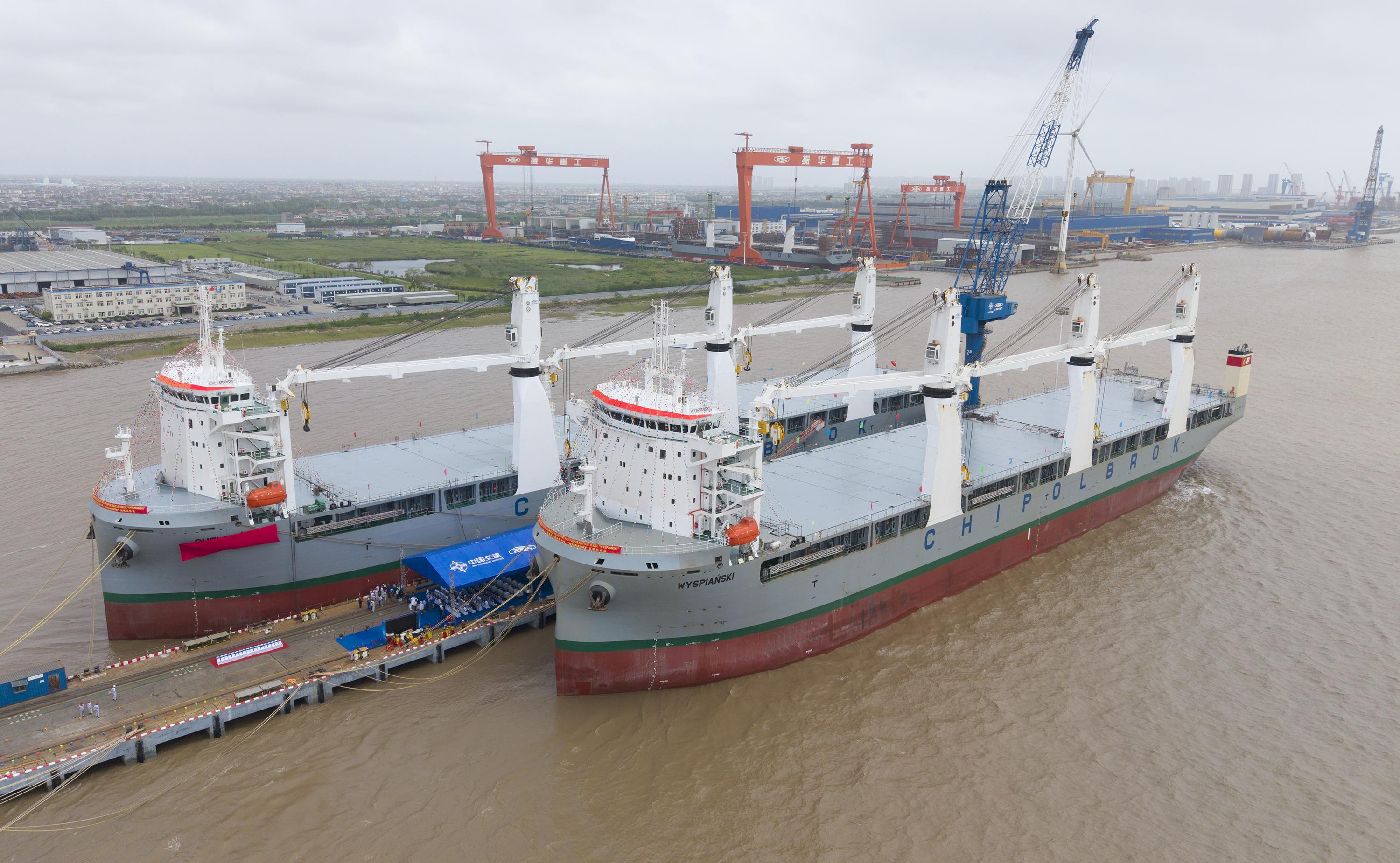
The new ships carry the new tasks of implementing the "Action Plan for Strengthening the Comprehensive Strategic Partnership between China and Poland (2024-2027)" (referred to as the Bilateral Action Plan) in its new phase. With new transport capacity, they further "provide maritime services for the development of China-Poland trade," adding strong momentum to the full-speed advancement of the friendship fleet.
Extra-large cargo holds: More flexible and adaptable
As distinctive new-generation ship types in the China-Poland fleet, these two sister ships have achieved a comprehensive breakthrough in loading capacity and adaptability. With a length of 182 meters, a width of 30 meters, a depth of 17 meters, a design draft of 9.8 meters, and a service speed of 14.5 knots, the fully loaded draft can reach 11.1 meters. The bow bridge design allows for a continuous flat deck area equivalent to 11 standard basketball courts, enabling the ships to carry 1.5 times more conventional-sized wind turbine blades than the current 30,000-ton vessels in the fleet.
The ships adopt a bow bridge and open continuous deck design, significantly enhancing deck loading space. The entire vessel is equipped with two cargo holds, with Hold No. 1 measuring 76.8 meters in length and 25 meters in width, setting a new record for the China-Poland fleet. Additionally, Hold No. 1 is equipped with six removable hatch covers, providing ample space for loading ultra-long, ultra-high, and ultra-heavy cargo. The cargo holds feature four layers of movable tween decks, allowing for the loading of various sizes of cargo, flexible compartmentalization, and the ability to open the entire hatch cover of Hold No. 1 for loading oversized items. This design fully meets the diverse and customized needs of global heavy and oversized equipment transportation.
In terms of lifting capacity, this ship type is equipped with three 350-ton electric cranes, with a dual-crane lifting capacity of 700 tons. This enables the ships to precisely handle the loading and unloading of ultra-heavy and oversized equipment under complex sea conditions, aiming to meet the transportation needs of large and heavy equipment and elevating the heavy-lift operation capabilities of the China-Poland fleet to a new level.
Going green: New technologies for better environmental protection
In the field of new shipbuilding, the China-Poland Company is making steady strides toward green and low-carbon development. This series of ships, designed with the operational characteristics of heavy-lift vessels in mind, incorporates unique energy-saving and emission-reduction features. The new ships introduce energy recovery technology, with electric cranes that recover potential energy when unloading heavy cargo, storing it in a 1,000 kWh power battery pack. This energy can then be used to support the power system during peak operations, reducing fuel consumption.
During navigation, the ships use low fuel consumption main engines equipped with shaft generators. The main engine drives the shaft generator to operate simultaneously, generating electricity to meet the power needs of the entire vessel, including living and operational equipment, without the need to run traditional diesel generators. This reduces fuel consumption and implements energy-saving and emission-reduction measures on every voyage.
Additionally, the new ship design fully integrates green and low-carbon concepts, featuring a pre-swirl stator, a rudder bulb, and shore power facilities. These allow the ships to achieve "zero emissions" while docked by utilizing shore power. The EEDI index meets Phase 3 standards, and NOx emissions comply with Tier III requirements, aligning with the development of the international maritime carbon tax compliance system. This demonstrates the China-Poland Company's active exploration and commitment to decarbonization in the shipping industry.
The two newly named ships are named after Polish artistic masters Stanisław Wyspiański and Józef Chełmoński. Wyspiański was a versatile figure in Polish cultural history, excelling in drama, poetry, painting, and architecture, while Chełmoński was renowned for his realistic landscape paintings. Naming the heavy-lift ships after these Polish art masters not only imbues them with cultural significance but also symbolizes the sincere cooperation and cultural exchange between China and Poland.
It is reported that "Wyspiański" and "Chełmoński" are the first ships in a series of four 38,000 DWT bow bridge-type multipurpose heavy-lift vessels ordered by the China-Poland Company. The series includes four ships, with the remaining two currently under construction and expected to be delivered and put into operation successively by 2027. By then, the overall capacity structure and green level of the China-Poland fleet will be further optimized, providing more efficient, professional, and environmentally friendly transportation services to global customers.
-
Yangpu Maritime escorts the safe docking of the inaugural vessel on the "Nanning-Yangpu, Hainan" direct inland-sea shipping route.4747
-
The Youthful "Voices" Riding the Waves: A Tribute to the Beihai Maritime Safety Center's Integrated Media Studio3145
-
Chongming Maritime Launches Special Escort Operation for the 2026 East China Sea "Fishing Opening"3844
-
Zhangzhou united multiple departments to carry out a water and land traffic safety campaign in schools.4119
-
The Nanjing Riverside Cruise welcomes its 3,000th voyage.5021